
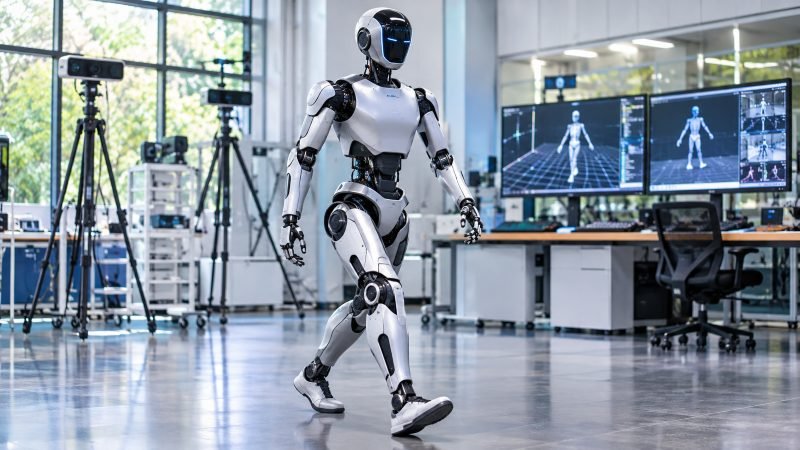
Humanoid robots learn to walk and balance by combining mechanical design, sensor feedback, control algorithms, and AI-based training. Walking is not just about moving legs forward. A robot must coordinate joints, shift weight at the right moment, place each foot accurately, and react instantly when the ground changes. Balance is equally demanding because every step briefly puts the robot in an unstable state. To handle that, engineers use inertial sensors, force sensing, motion planning, and real-time controllers that constantly correct posture. Machine learning adds another layer by helping robots practice movement strategies in simulation before applying them in the physical world. Together, these systems allow humanoid robots to move more naturally, recover from disturbances, and operate more reliably in complex environments.
1. How Do Humanoid Robots Achieve Natural Walking?
Understanding Gait Cycles, Joint Coordination, and Foot Placement
Humanoid robots achieve natural walking by following a gait cycle similar to human motion: weight shifts, one leg swings forward, the foot lands, and the body transfers support to the next step. To do this smoothly, the robot coordinates hip, knee, ankle, and torso joints in precise timing. Controllers calculate stride length, step frequency, and foot angle so the center of mass stays within a stable range. Foot placement is especially important on uneven terrain, where slight errors can cause slips or wasted energy. By adjusting each step based on terrain data and body motion, the robot produces movement that looks more fluid, uses energy more efficiently, and remains stable during continuous forward motion.
How Motors and Mechanical Structures Support Human-Like Movement
Natural walking also depends on the robot’s hardware. Motors, actuators, joint linkages, and structural geometry determine how closely movement can resemble human motion. A full-size humanoid such as LimX Oli stands 165 cm tall and offers up to 31 degrees of freedom, giving it a wider range of postures and finer joint coordination. More degrees of freedom let the robot bend, rotate, and shift weight with better control during stepping and turning. Its independent compute systems for motion control and perception also help separate low-latency movement commands from environmental processing. When paired with rigid but balanced mechanical design, these elements support smoother trajectories, better shock absorption, and more stable, human-like locomotion.
2. How Do Humanoid Robots Maintain Balance While Moving?
The Role of IMUs, Sensors, and Real-Time Feedback
Humanoid robots maintain balance by constantly measuring body motion and comparing it to the intended posture. An IMU tracks acceleration, rotation, and tilt, helping the control system estimate whether the robot is leaning too far or moving off its planned path. Additional sensors, including depth cameras and joint encoders, provide information about terrain, body position, and limb movement. Real-time feedback loops then adjust joint torques and foot placement within milliseconds. On a platform like LimX Oli, a self-developed 6-axis IMU improves anti-interference performance and reduces drift, while head-mounted and chest-mounted Intel® RealSense™ D435i depth cameras support wide-range perception, obstacle avoidance, and close-range environmental awareness for safer motion control.
How Dynamic Balance Control Helps Robots Recover From Instability
Balance during walking is dynamic, not static. A humanoid robot is often briefly unstable when one foot leaves the ground, so it must actively recover rather than simply hold a fixed pose. Dynamic balance control predicts how momentum, joint motion, and ground contact will affect the next moment of movement. If the robot slips, gets nudged, or lands unevenly, the controller can widen the step, shift the torso, swing the arms, or change ankle torque to regain stability. These corrections happen continuously and automatically. Effective recovery control allows the robot to keep moving instead of stopping after every disturbance, which is essential for walking on varied surfaces and operating in real, changing environments.
3. How Do AI and Machine Learning Teach Robots to Walk?
Reinforcement Learning, Simulation, and Trial-and-Error Training
AI helps humanoid robots learn walking strategies that would be difficult to hand-program step by step. In reinforcement learning, the robot practices in simulation and receives rewards for stable, efficient movement and penalties for falling or wasting energy. Over many trial-and-error cycles, it learns how to coordinate joints, recover from disturbances, and adapt gait patterns. Simulation is useful because it allows millions of safe repetitions under different slopes, surfaces, and push conditions without risking hardware damage. Engineers also vary robot mass, friction, and sensor noise during training so the learned behavior becomes more robust. This process often produces flexible walking policies that respond better to uncertainty than fixed, rule-based control alone.
Sim-to-Real Transfer: Applying Learned Walking Skills to Physical Robots
A robot that walks well in simulation still needs to perform reliably in the physical world, where sensors drift, motors lag, and floors are imperfect. Sim-to-real transfer bridges that gap by training models under realistic noise and then fine-tuning them on the actual robot. Engineers calibrate the controller using real sensor data, actuator limits, and contact behavior so learned policies remain stable outside the simulator. This is where integrated perception and control hardware matter. A robot with strong onboard sensing and computing can apply learned walking skills faster and more safely. Once transferred successfully, AI-trained locomotion lets humanoid robots handle uneven terrain, unexpected disturbances, and more natural movement in real operational settings.
Conclusion
Humanoid robots learn to walk and balance through a tightly connected system of mechanics, sensing, control, and AI training. Natural gait comes from coordinated joints, accurate foot placement, and structures that support smooth movement. Stable motion depends on IMUs, depth sensing, and real-time feedback that detect changes in posture and terrain. Dynamic balance control helps the robot recover when a step goes wrong, while machine learning improves adaptability by training locomotion policies through repeated simulation. When those learned skills transfer successfully to physical hardware, robots can move with greater confidence in real environments. The result is not just forward motion, but controlled, responsive locomotion that allows humanoid robots to operate more safely, efficiently, and naturally across a wider range of tasks.